




No products in the cart.
Buyer’s guide series · Part 06 of 9
Why the stainless grade on a composting machine decides its service life, how SS 202 gets substituted, and how to specify material of construction properly.
Written & reviewed byDevanshu Daga, Founder, The Green Machine Co. (ISB PGP; Six Sigma Black Belt)
Last updated19 October 2026
Reading time6 minutes
Of every line on a composting machine quotation, material of construction moves the price most and moves the service life more. It is also the line where substitution is easiest and hardest to detect, because the three options look broadly similar on delivery day and diverge only after a couple of monsoons.
What the Machine’s Environment Does to Metal
Before comparing grades, understand the service condition, because it is more aggressive than most buyers assume.
Inside the chamber you have organic acids from decomposing food. You have chlorides from salt, and Indian cooking puts a great deal of salt into food waste. You have permanent moisture. You have elevated temperature, which accelerates every corrosion mechanism. And you have mechanical abrasion from the agitator dragging material against the wall.
Hot, wet, salty, acidic and abrasive, continuously, for ten years. That combination is why this decision matters more here than it would on a machine handling dry material.
SS 304
The austenitic stainless grade specified for food-contact and wet corrosive service.
Its corrosion resistance comes from chromium forming a passive oxide layer, with nickel stabilising the structure and improving resistance in acidic conditions. In the service condition above, it holds up. This is the grade specified for food processing equipment, commercial kitchen equipment and chemical handling, for exactly these reasons.
It is the most expensive of the three, and it is the correct choice for the chamber and every component that touches the waste.
SS 202
A lower-nickel, higher-manganese stainless grade, developed originally as a cost-saving substitute during periods of high nickel prices.
In dry or mildly corrosive service, SS 202 performs perfectly acceptably. It is widely and legitimately used in furniture, railings and architectural applications. Nobody is arguing it is a bad material.
The problem is specific to this application. In hot, chloride-rich, acidic conditions SS 202 is markedly more susceptible to pitting corrosion than SS 304. Pitting is localised attack that starts as small dark spots, progresses into pinholes and eventually perforates. Once pitting starts inside a chamber it also becomes a hygiene issue, because pits trap residue that cannot be washed out.
Here is why it matters commercially. SS 202 and SS 304 are visually indistinguishable when new. A polished SS 202 chamber looks exactly like a polished SS 304 chamber on handover day. The difference shows up in year two or three, well past the point where you can do anything about it.
On the magnet test: you will be told that stainless is non-magnetic and that a magnet distinguishes the grades. Treat this as a weak indicator at best. Both grades are austenitic, cold working can induce magnetic response in either, and the test cannot distinguish 304 from 202 reliably. It is not a substitute for documentation.
MS with Epoxy or Powder Coating
Mild steel, typically to IS 2062, with a protective coating.
This is the cheapest option by a wide margin, and it is a legitimate choice for parts of the machine. But understand the logic: mild steel has no inherent corrosion resistance in this environment, so the life of the component becomes the life of the coating.
Coatings fail predictably, and they fail first at welds, where surface preparation is hardest; at edges and corners, where coating thickness is thinnest; anywhere the operator’s shovel or scraper contacts during discharge; and anywhere a fastener passes through.
Once the coating breaks at any of these points, corrosion proceeds underneath it and spreads laterally, lifting more coating as it goes. The visible rust spot is always smaller than the actual affected area.
MS coated is defensible for the frame, the base and outer cladding. Inside the chamber, in this service condition, it is a false economy.
How to Specify It Properly
Do not accept, or write, a single MOC line for the whole machine. Specify component by component.
| Component | Recommended | Acceptable | Not recommended |
|---|---|---|---|
| Chamber / vessel inner | SS 304 | — | SS 202, coated MS |
| Agitator shaft | SS 304 | — | Coated MS |
| Paddles / blades | SS 304 or hardened wear grade | — | Coated MS |
| Discharge door and seal face | SS 304 | — | SS 202, coated MS |
| Outer cladding | SS 304 | SS 202 | — |
| Frame / base | Coated MS (IS 2062) | — | — |
| Fasteners in wet zone | SS 304 | — | Plated MS |
That last row is small and frequently overlooked. Plated mild steel fasteners in the wet zone rust and seize, which turns a routine maintenance job into a cutting job.
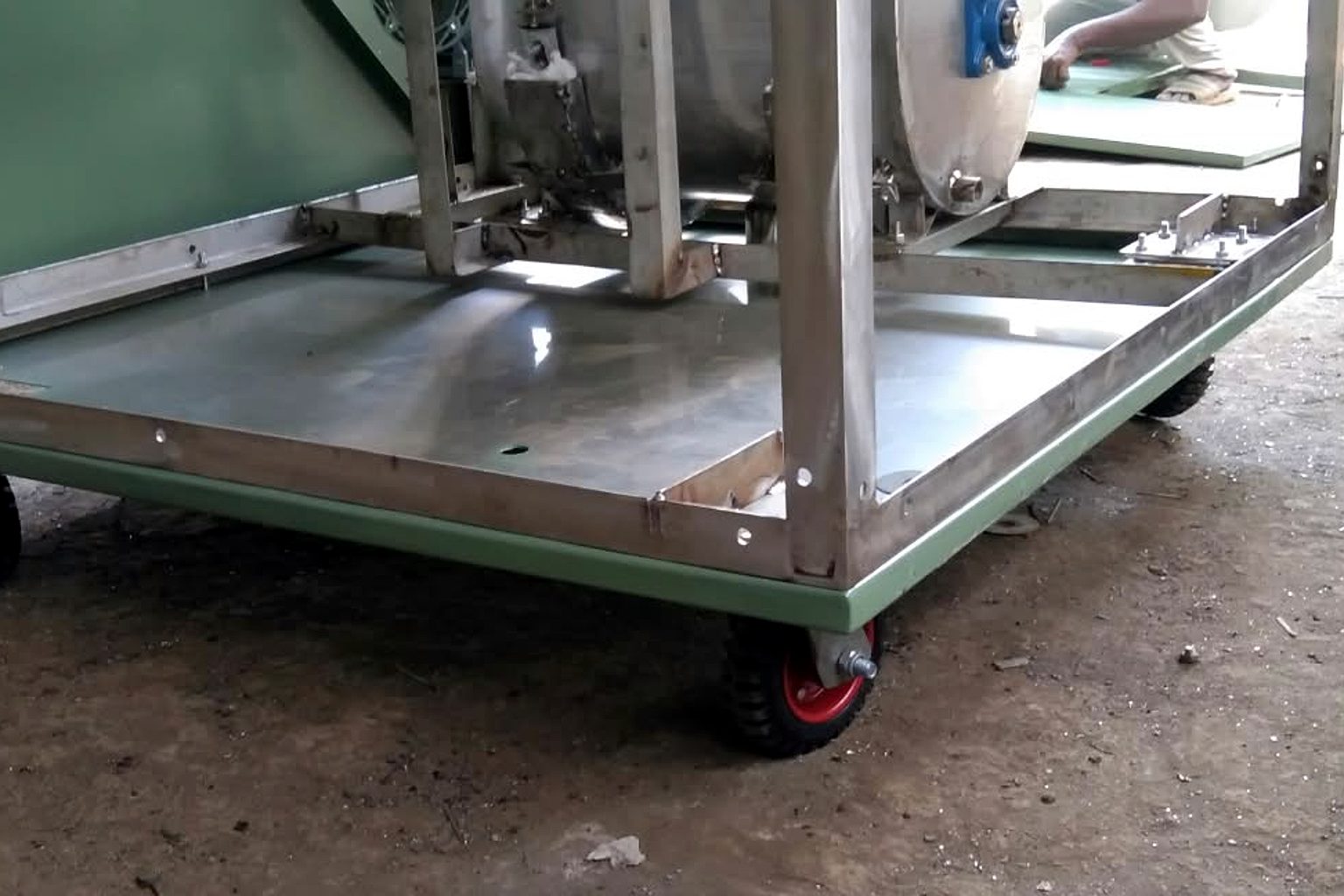
What TGMC uses. On TGMC composters the process vessel, every part that touches the waste, and the frame are SS 304, made from branded stainless sheet from mills such as Jindal Stainless. Where a customer asks for it, we build the frame in IS 2062 mild steel with a protective coating instead. Motors, gearboxes and bearings are branded, industrial-duty parts. Mill test certificates for the stainless sheet are available on request.
Getting Proof Rather Than Assurance
Specifying the grade is the easy half. Verifying it is the half that gets skipped.
Ask for mill test certificates for the plate used in your machine. Not a brochure claim, not a general statement about company policy, but the MTC for the material batch. A supplier who buys plate against specification and keeps records produces these without difficulty. One who assembles machines from whoever quoted cheapest that month cannot.
Put the grade on the purchase order, component by component, with the MTC requirement as a delivery condition. If it is only in the conversation, it is not in the contract.
Consider a positive material identification test on the chamber at handover for a large purchase. PMI is inexpensive relative to the machine and it is the only method that actually settles the question. Simply telling the supplier at quotation stage that you intend to do this changes behaviour usefully.
The Cost Argument, Honestly
SS 304 throughout will price above SS 202 throughout, which will price above coated MS. Over a ten-year life the calculation usually favours the better grade in the wet zone, because a perforated or heavily pitted chamber is not economically repairable. It is a machine replacement.
But be equally honest about the other direction. Specifying SS 304 for the frame and outer cladding is money spent on something that does not need it. The frame lives in a comparatively benign environment. Paying stainless prices for structural steel is over-specification, and a supplier who encourages it is not necessarily acting in your interest either.
The right answer is grade matched to service, component by component, with documentation.
Frequently Asked Questions
Is SS 202 a bad material?
No. It is a legitimate grade that performs well in dry and mildly corrosive service. It is the wrong choice specifically for hot, wet, chloride-rich conditions inside a composting chamber.
Can I tell SS 304 from SS 202 by looking at it?
No. They are visually indistinguishable when new. The magnet test is unreliable for this purpose. Mill test certificates or a PMI test are the only dependable methods.
Is a mild steel machine ever acceptable?
For the frame, base and outer cladding, yes. For the chamber and contact parts in this service condition, it is a false economy.
How much does the grade change the price?
Enough to be visible on a quotation, which is precisely why substitution happens. Ask each supplier to price the same machine in two configurations so you can see the difference rather than guess at it.
Next Steps
For the rest of the specification sheet, see OWC specifications decoded. To take this into a supplier meeting, see the 15 questions to ask, and for the whole decision, the complete buyer’s guide.
Next step
Know your daily wet-waste figure? We will check it against a machine size.
A TGMC engineer walks your site, measures the access route and the power supply, and puts the kg-per-day basis in writing before any quotation is issued.
Or call +91 90737 96770 · info@tgmc.co.in
Written and technically reviewed by Devanshu Daga, Founder, The Green Machine Co., Kolkata (ISB PGP; Six Sigma Black Belt). Last updated 19 October 2026.
Continue the series