




No products in the cart.
Buyer’s guide series · Part 01 of 9
An organic waste converter turns food waste into a soil-like output on your own premises. Here is what it does, what it doesn’t, and who needs one.
Written & reviewed byDevanshu Daga, Founder, The Green Machine Co. (ISB PGP; Six Sigma Black Belt)
Last updated19 October 2026
Reading time6 minutes
What Is an Organic Waste Converter?
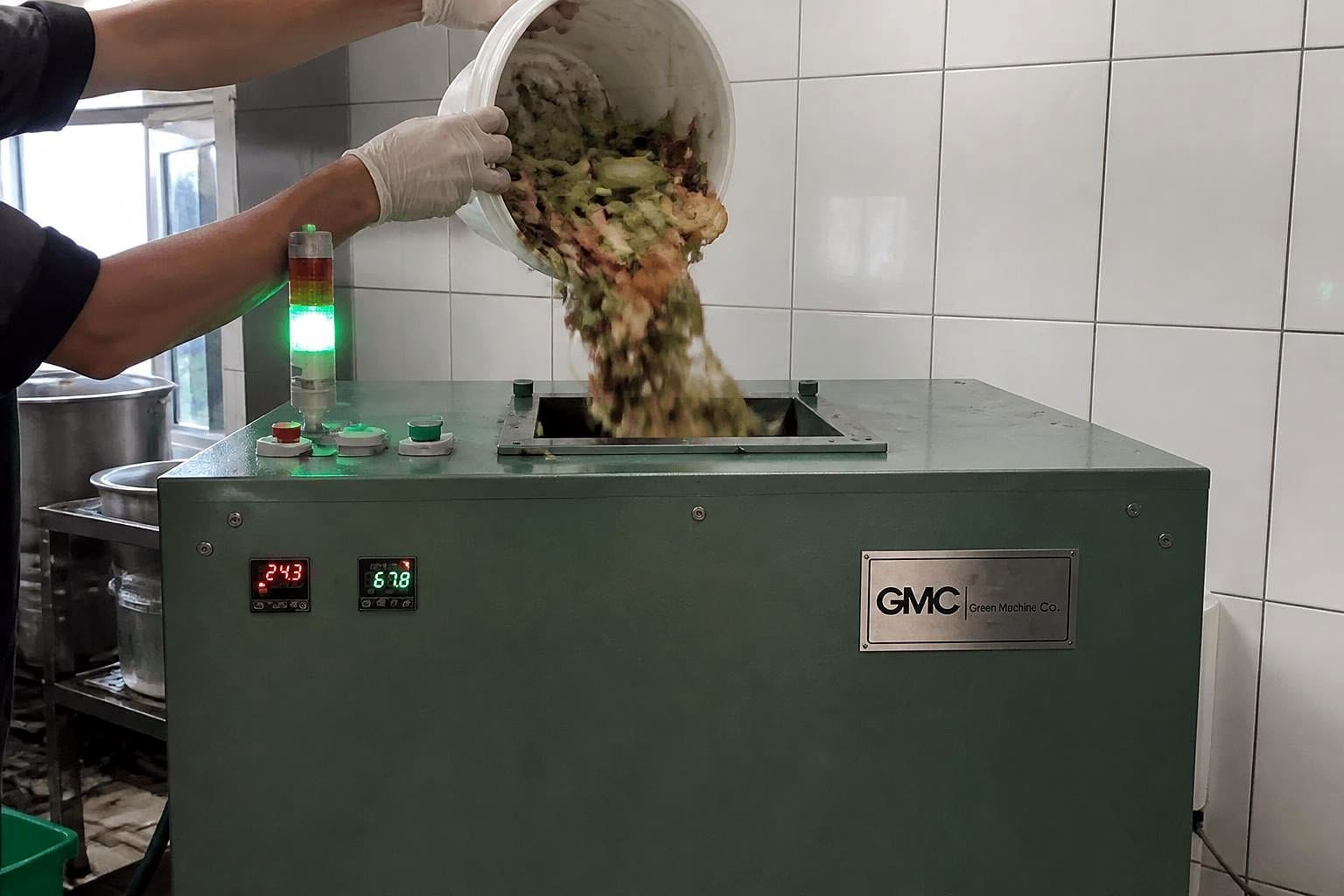
An organic waste converter (OWC) is an enclosed machine that processes food and garden waste on the premises where it is produced, turning it into a soil-like material. It shreds the waste, then holds it under controlled heat, air and microbial action instead of sending it to landfill. Cycle times range from a few hours to about a day depending on the design.
OWC is short for organic waste converter. The same category of machine gets called an organic waste composting machine, a food waste composting machine, a wet waste management machine or, loosely, a composter. Tender documents usually say organic waste converter. Hotel engineering teams usually say OWC.
The Easiest Way to Understand It
Think about vegetable peel in a covered bucket in your kitchen. Within two days it smells foul, goes slimy and attracts flies. Now think about leaves on a forest floor. Over months they quietly turn into dark, crumbly soil with no smell at all.
Both are the same process. The difference is oxygen.
In the sealed bucket, the bacteria that work without oxygen take over. They are slow, and their by-products are the gases that smell like rot. On the forest floor air circulates freely, so a different set of bacteria dominates. These are fast, they generate heat as they work, and they produce almost no smell.
An organic waste converter is a machine built to force the forest-floor version to happen indoors, in a day instead of a season. Everything it does exists to keep the fast, oxygen-loving bacteria winning.
What Actually Happens Inside
1. Size reduction
A shredder or crusher breaks incoming waste into small pieces. This matters more than it sounds. Bacteria can only work on surfaces, so a whole cabbage offers them very little to attack, while the same cabbage in 10 mm pieces offers an enormous amount. Cutting particle size is the cheapest way to speed up everything that follows.
2. Mixing and aeration
An agitator, usually a shaft with paddles, turns the mass continuously or at intervals. Most machines also push air through with a blower. This keeps oxygen reaching every part of the material and stops wet pockets forming where anaerobic bacteria could take hold. This is the stage that decides whether your machine smells.
3. Heat
The bacteria generate their own heat as they work, and most machines add heating as well to reach and hold the thermophilic range. Heat speeds up decomposition and reduces pathogens, fly larvae and weed seeds, which is what makes the output safer to handle.
4. Moisture removal
Indian kitchen waste is very wet, and water is the enemy here. It fills the air gaps between particles, oxygen cannot get through, and the process flips back to the sealed-bucket version. So machines drive off moisture as vapour, and many designs call for a dry bulking agent such as sawdust or cocopeat to be added with the waste to soak up excess water and hold structure.
More on the underlying biology: the science of composting.
What Comes Out
At the end of the cycle you get a dry, dark, greatly reduced material with an earthy smell. Volume reduction is substantial, and most of the loss is water.
Here is the part that gets glossed over in sales conversations, and it is where machines genuinely differ.
On many machines the output is not finished. It is stabilised and odour-free, but biologically still active, and it needs a curing period, typically two to three weeks in a covered bin or bay, before it is a mature soil amendment you can use around plants. If you buy one of these, plan curing space when you plan the machine. Sites that forget end up with sacks of half-processed output piling up in a corridor.
On other machines the process is designed to complete inside the machine.
TGMC’s composters complete their machine cycle in 4 to 6 hours. Independent testing by a NABL-accredited laboratory on a 1,000 kg production lot returned a C:N ratio of 17.11:1, inside the FCO benchmark of 20:1, with E. coli and Salmonella both absent. The report is available on request from our quality team at info@tgmc.co.in.
Both designs exist, and the difference changes what your site needs. Do not accept either claim on assurance, from us or from anyone else. Ask for the laboratory report and look at what it actually measures.
What an OWC Is Not
It is not a biogas plant. A biogas plant does the opposite, excluding oxygen deliberately so that slow anaerobic bacteria produce methane you can burn as fuel. Different technology, different economics, different site requirements. It suits some sites better than an OWC does.
It is not a waste disposal unit or sink grinder. Those grind food waste and flush it into the drain. They move a problem rather than solving one, and they load your sewage system.
It is not a substitute for segregation. The machine cannot separate a plastic spoon from potato peel. Whatever goes in comes out, shredded. Contaminated input means contaminated output, blunted blades and eventually a machine nobody wants to operate. Our guide to wet and dry waste segregation covers how to get this right first.
It is not automatic in the sense of unattended. Even a fully automatic machine needs somebody to load it, discharge it and clean it every day.
Who Typically Installs One
Any premises producing enough wet waste in one place to make on-site processing worthwhile. In practice: hotels, resorts and banquet venues; restaurants, cloud kitchens and food courts; housing societies and apartment complexes; malls and supermarkets; hospitals, schools, colleges and corporate campuses; temples and community kitchens; and municipal wards running decentralised processing.
The two reasons people buy are compliance and cost. Under the Solid Waste Management Rules 2016, bulk waste generators carry an obligation to process biodegradable waste within their own premises as far as possible. Separately, if you currently pay a contractor to haul wet waste away, on-site processing converts that recurring cost into a one-time purchase plus a smaller running cost.
Below roughly 10 kg a day, a machine is usually not the right answer. Manual or semi-manual composting is cheaper and works perfectly well at that scale.
Frequently Asked Questions
What is the full form of OWC?
OWC stands for organic waste converter.
How long does an organic waste converter take?
It varies by design. Many machines run a cycle of around 24 hours and produce a material that needs a further two to three weeks of curing. TGMC’s composters complete their machine cycle in 4 to 6 hours.
TGMC’s composters complete their machine cycle in 4 to 6 hours. Supported by independent testing at a NABL-accredited laboratory.
Does it smell?
A correctly sized, correctly loaded machine with proper aeration and exhaust routing should not produce noticeable odour in surrounding areas. Odour complaints usually trace back to overloading, poor segregation or exhaust routed to the wrong place, not to the technology.
What can’t go in?
Plastics, metal, glass, cutlery, packaging, large bones, and large volumes of liquid. Some designs also restrict coconut shell and heavy woody material unless a shredder section is fitted.
Is the output the same as compost you buy?
Where the process is complete at discharge it is a genuine soil amendment, though its nutrient content depends entirely on what went into the machine. Where the machine discharges an immature material, it becomes one only after curing. Ask which case applies, and ask for the test data.
Can it be used on any crop?
Not without care. Compost from mixed food waste can carry E. coli, which is normal for the feedstock and manageable, but it means the output should not go on crops eaten raw without further composting or curing. Ask for the microbiological section of the test report, not only the nutrient analysis.
Next Steps
To work out what size machine your site needs, start with how to size a composting machine. For the full picture on specifying and buying one, see the complete buyer’s guide. To see the range organised by kg per day, visit our composter machines.
Next step
Know your daily wet-waste figure? We will check it against a machine size.
A TGMC engineer walks your site, measures the access route and the power supply, and puts the kg-per-day basis in writing before any quotation is issued.
Or call +91 90737 96770 · info@tgmc.co.in
Written and technically reviewed by Devanshu Daga, Founder, The Green Machine Co., Kolkata (ISB PGP; Six Sigma Black Belt). Last updated 19 October 2026.
Continue the series
Next in the buyer’s guide
02 · SizingHow to Size a Composting MachineThe seven-day method, an audit sheet and a worked example.03 · AutomationFully Automatic vs Semi-Automatic OWCWhich one wins depends on the operator hours you actually have.04 · Buying15 Questions to Ask Before You Buy a Composting MachineThe list to take into the meeting, and the answers to listen for.