


How to size, specify and buy an organic waste converter in India. Capacity, SS 304 vs SS 202, site requirements, running costs and the seven mistakes buyers make.
Most organic waste converter purchases go wrong at the sizing stage, long before anyone has looked at a machine. Get the daily kilos right and the rest of the decision follows. Get them wrong and you have bought the wrong footprint, the wrong power connection and the wrong operator workload, and no amount of after-sales support will fix it.
An organic waste converter, or OWC, is an enclosed machine that turns food and garden waste into a soil-like output on your own premises. It does this through controlled shredding, heating, aeration and microbial action. Cycle times range from a few hours to a full day, and the maturity of what comes out varies a great deal between designs. Buyers generally arrive for one of two reasons: an obligation under the Solid Waste Management Rules 2016, or the cost of paying someone to haul wet waste away every day.
This guide covers what to measure, what to ask, and what goes wrong.
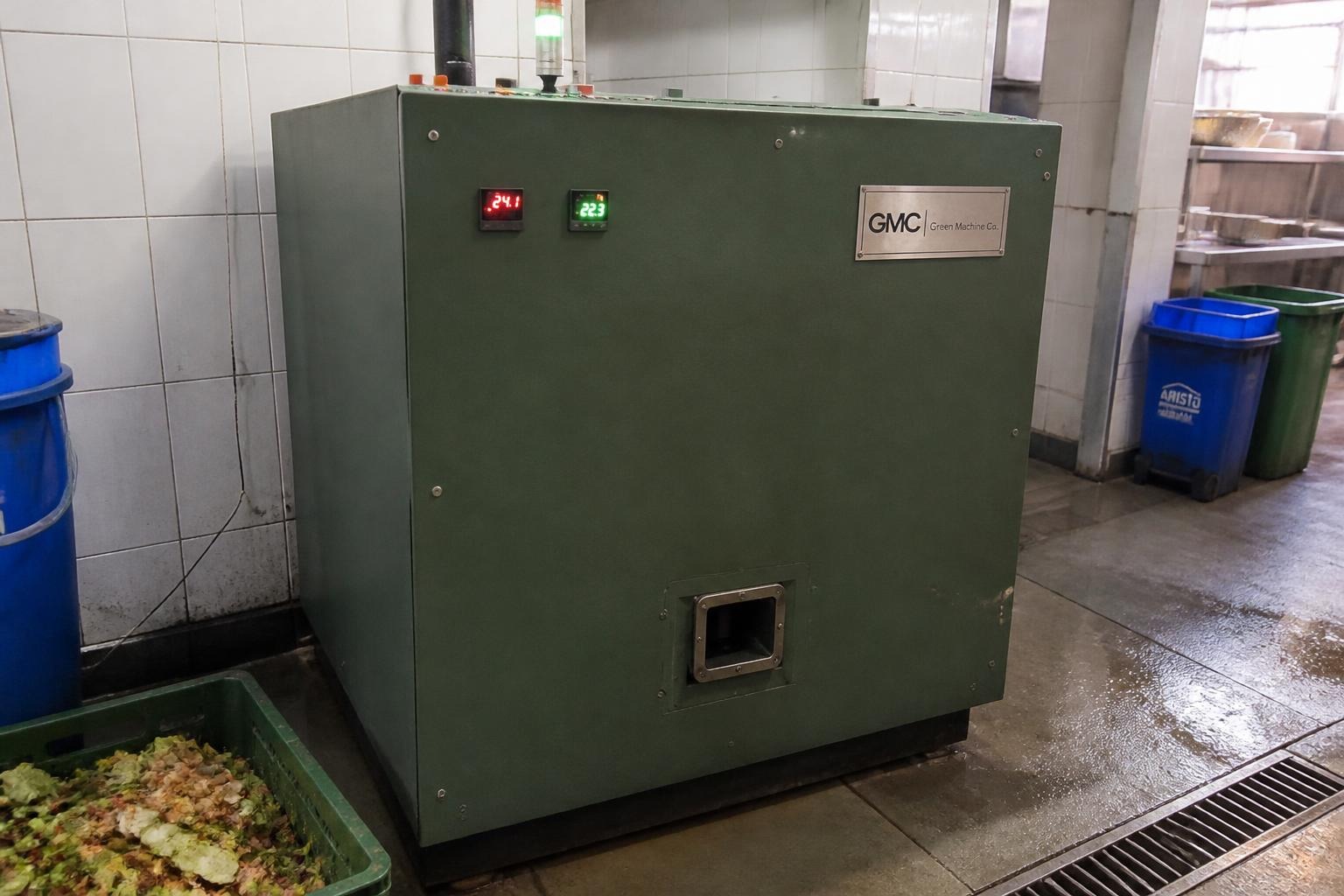
What an Organic Waste Converter Actually Does
Every OWC performs the same four steps in sequence. It shreds, because small particles decompose faster than large ones. It aerates, because an aerobic process generates its own heat and does not smell. It holds temperature, because the thermophilic range speeds up breakdown and kills pathogens. And it removes moisture, because wet Indian kitchen waste left as it is will putrefy rather than compost.
Machines differ in how far they take that process. Some discharge material that is stabilised but not mature, and it needs two to three weeks in a covered curing bay before it goes near a plant. Others are designed to finish the job inside the machine.
The difference is commercial, not academic. A machine that discharges immature material needs curing space, someone to turn it, and somewhere to store it while it matures. A machine that discharges finished material does not. That is floor area and labour, every month, for the life of the machine.
So ask every supplier the same three questions together, and do not let them be answered separately: what is the cycle time, is the discharged material finished or intermediate, and what laboratory evidence supports that answer?
TGMC’s composters complete their machine cycle in 4 to 6 hours. Independent testing by a NABL-accredited laboratory on a 1,000 kg production lot returned a C:N ratio of 17.11:1, inside the FCO benchmark of 20:1, with E. coli and Salmonella both absent. The report is available on request from our quality team at info@tgmc.co.in.
If you want the plain-English version of how the machine works and what it is not, start with what is an organic waste converter.
Volume reduction is substantial whichever route the machine takes. Most of what disappears is water. If you want the underlying biology, we have written it up separately in the science of composting.
Who Needs One, and Who Doesn’t
Two things drive the decision, and they are worth separating.
Compliance. Under the Solid Waste Management Rules 2016, bulk waste generators are required to segregate their waste and process the biodegradable fraction on the premises as far as possible. How hard that is enforced depends on your state and your municipal body, and it varies more than most buyers expect.
Economics. If you pay a contractor per trip to remove wet waste, an on-site machine converts a recurring cost into one capital purchase plus a smaller running cost. That arithmetic only works above roughly 10 kg of wet waste a day. Below it, manual composting in bins or pits is cheaper and simpler, and you should do that instead.
There is a third case where the answer is no regardless of volume. If your waste stream arrives full of plastic wrappers, cutlery and packaging, a machine will not help you. It cannot separate a spoon from a potato peel. Fix segregation at source first, then buy the machine. Our guide to wet waste versus dry waste segregation covers how to set that up.
Sizing: The Number That Decides Everything Else
Capacity is quoted in kilograms of input per day. Every other decision hangs off it: price, footprint, power connection, operator time, even where the machine can physically stand.
Measure it. Weigh the wet waste at the point where it is generated, every day for seven consecutive days. Include a weekend, and include an event day if you run events. This is the only number in the whole exercise that is actually yours.
Then cross-check it. Compare your measurement against published per-unit planning rates for your type of facility. If the two disagree by more than about 20%, something in your measurement is wrong, or something in your operation is unusual and worth understanding before you buy.
Typical wet-waste figures for cross-checking your own measurement
| Facility type | Measured | Typical wet waste |
|---|---|---|
| Business hotel | per occupied room per day | 1,000–1,500 g |
| Hotel with banquets | per occupied room per day | 2,000–4,000 g |
| Full-service restaurant | per cover served | 300–400 g |
| Quick-service restaurant | per cover served | 100–150 g |
| Housing society | per flat per day | 800–1,000 g |
| Corporate canteen | per meal served | 180–250 g |
| Hospital | per occupied bed per day | 400–600 g |
These are TGMC planning estimates for Indian sites, wet (compostable) waste only. Use them to check your own seven-day measurement, not to replace it.
Two adjustments then apply to whatever number you land on.
Size for your busiest realistic day rather than your average. A hotel that averages 80 kg but hits 140 kg during a wedding season has a 140 kg problem. A machine that is overloaded on forty days a year is a machine that fails on forty days a year, and those are the days when the kitchen is under the most pressure and least able to cope.
Then add 20 to 30% headroom. Occupancy grows, covers grow, and segregation discipline usually improves after installation, which means more waste reaches the machine than reached your seven-day survey.
The full seven-day method, with an audit sheet and a worked example, is in how to size a composting machine.
One warning. Never let a supplier size the machine over the phone. If a quotation arrives without anyone having interrogated your kg-per-day basis, you have learned something about how the rest of that engagement will go.
Machine Types and Automation
Which of these matters most is covered in fully automatic vs semi-automatic.
Automation level. A fully automatic machine costs more to buy and less to run in labour terms. A semi-automatic machine is the reverse. Which one wins depends on how many operator hours you realistically have available, which is a different question from how many you are budgeting for.
Integrated shredder. Worth having if your site produces woody material such as branches, garden prunings or coconut shells. Skip it if you are handling kitchen waste alone. If your woody volumes are large enough to justify separate handling, a standalone shredding machine may suit you better than an integrated unit.
Batch or continuous. Batch machines are simpler and easier to control, and the operator knows exactly what state the machine is in. Continuous machines suit high-volume sites where waste arrives all day and there is no natural point to close a cycle.
Controller type. Timer-based relay control is cheap and any competent electrician can repair it. PLC control gives you cycle logging and fault codes, which is worth having in itself and is sometimes a stated requirement in government tenders. Read the tender specification before you choose, not after.
Specifications Worth Interrogating
Most specification sheets in this market are written to be agreed with rather than examined. The right column below is what to ask.
Each of these lines is explained in full, with a sheet for normalising two quotations side by side, in OWC specifications decoded.
The capacity line deserves particular attention. Two suppliers can both write “100 kg/day” and mean entirely different things, one quoting input and the other nominal chamber fill, measured at different moisture contents. Insist that the basis appears on the quotation itself. A supplier who will not put it in writing has told you why.
Body Material: SS 304, SS 202 or MS
This one choice moves both the price and the service life more than anything else on the specification sheet.
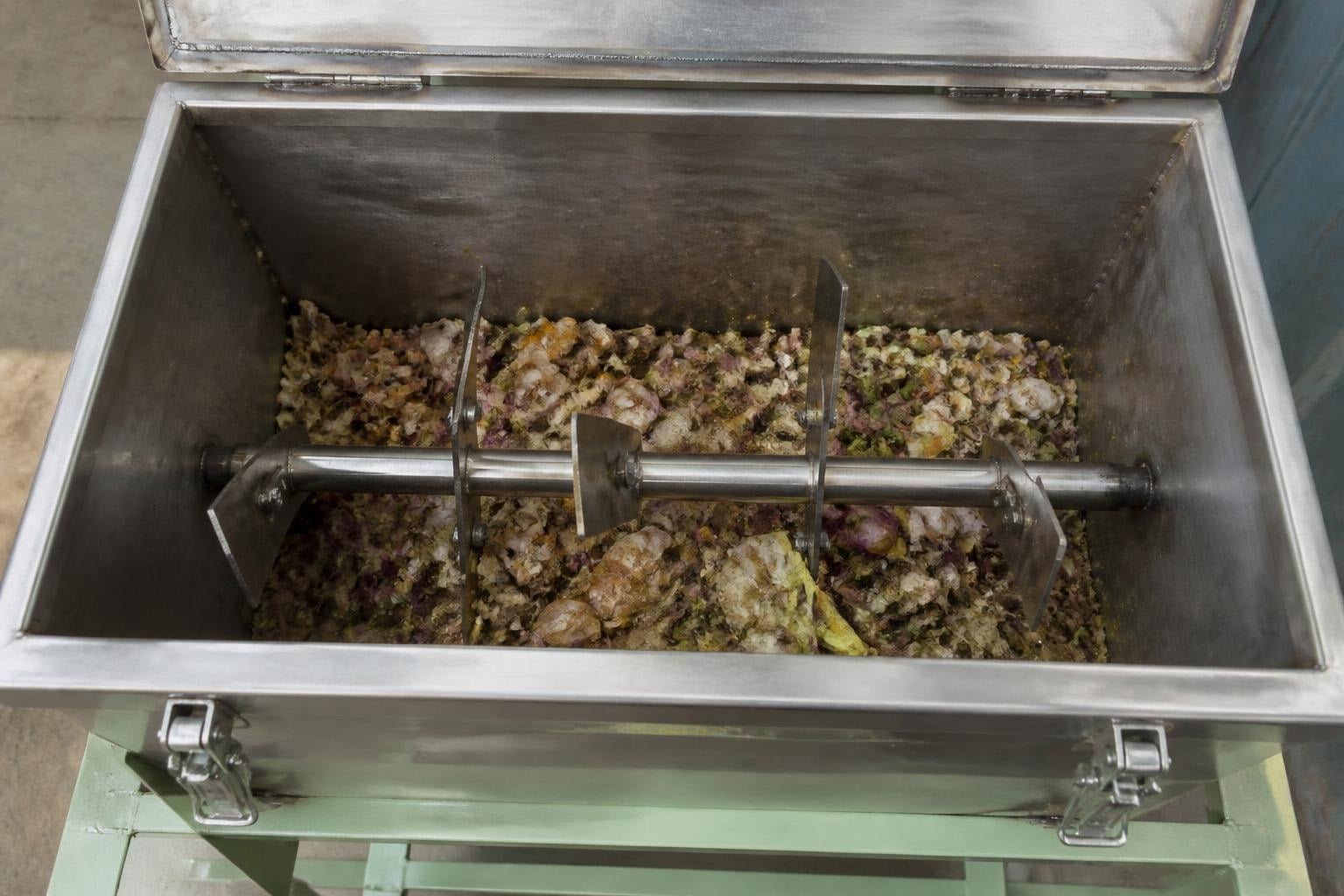
SS 304 is the correct austenitic grade for hot, wet, chloride-rich service, which is exactly what food waste is. It survives. It is also the most expensive, and it is the right answer for the chamber and every wetted part.
SS 202 has less nickel, costs less, and looks identical on delivery day. In this service it pits and stains by year two or three. It is common in this market for precisely that reason: the difference only becomes visible after the warranty has expired and the salesman has moved on.
Mild steel with an epoxy coating is the cheapest option. The coating is the only thing protecting the metal, so the life of the machine becomes the life of the coating. Coatings fail first at the welds and along the edges an operator scrapes with a shovel every day.
The grades, the service condition and a component-by-component specification table are in SS 304 vs SS 202 vs MS epoxy.
A sensible middle path is to specify by component rather than by machine: SS 304 for the chamber and internals, a lower grade for the outer cladding and frame if the budget demands it. Then ask for mill test certificates covering the plate used in your machine, not a generic statement in a brochure. Suppliers who can produce them are running a different kind of operation from suppliers who cannot, and that difference will show up again in year four.
What to Check on Site Before Delivery
The printable version, with every check itemised, is the site readiness checklist.
Confirm all of this before the machine leaves the works. Every item on this list has, somewhere, stopped a delivery at the gate.
- Space. Footprint plus working clearance for loading, discharge, maintenance and pulling a component out.
- Access route. Measure the entire path from the truck to the final position: gate width, corridor width, door heights, lift capacity, turning radius, kerbs.
- Floor. Level and load-bearing. Check the machine’s operating weight, not its dry weight, against the floor’s capacity.
- Power. Three-phase supply sized to the connected load, an isolator within the operator’s reach, and proper earthing.
- Water and drainage. A wash-down tap and a floor drain for leachate. Find out where that drain actually discharges.
- Ventilation. Exhaust to open air, positioned with the prevailing wind and any nearby occupied windows in mind.
- Output handling. Covered and ventilated. If the machine discharges immature material, size this as a curing area: daily output multiplied by the curing period. If it discharges finished material you need less, but you still need somewhere to keep it until it is collected or used.
What It Costs to Run
Purchase price scales with capacity, body material, automation and whether a shredder is integrated. Two quotations for the same nominal capacity can differ substantially, and the cheaper one is not automatically the worse buy, though it usually is.
The number that decides whether the machine was a good idea is the total cost of ownership. Over ten years it will exceed the purchase price. It is made up of:
- Power, for the heater and motors, at your commercial tariff. This dominates.
- Microbial culture, which is a recurring consumable in most designs.
- Bulking agent such as sawdust or cocopeat, as required.
- Labour for loading, discharge and cleaning.
- Maintenance and spares: blades, seals, bearings, belts.
- An annual maintenance contract once the warranty ends.
Set that total against what you currently pay to have wet waste hauled away. For most commercial sites generating well above the 10 kg threshold, the payback is visible without needing a spreadsheet to find it. If it is not visible, the machine is probably the wrong answer for your site.
Choosing a Manufacturer
The long version is in how to vet an OWC manufacturer, and the questions to take into the meeting are in 15 questions to ask before you buy.
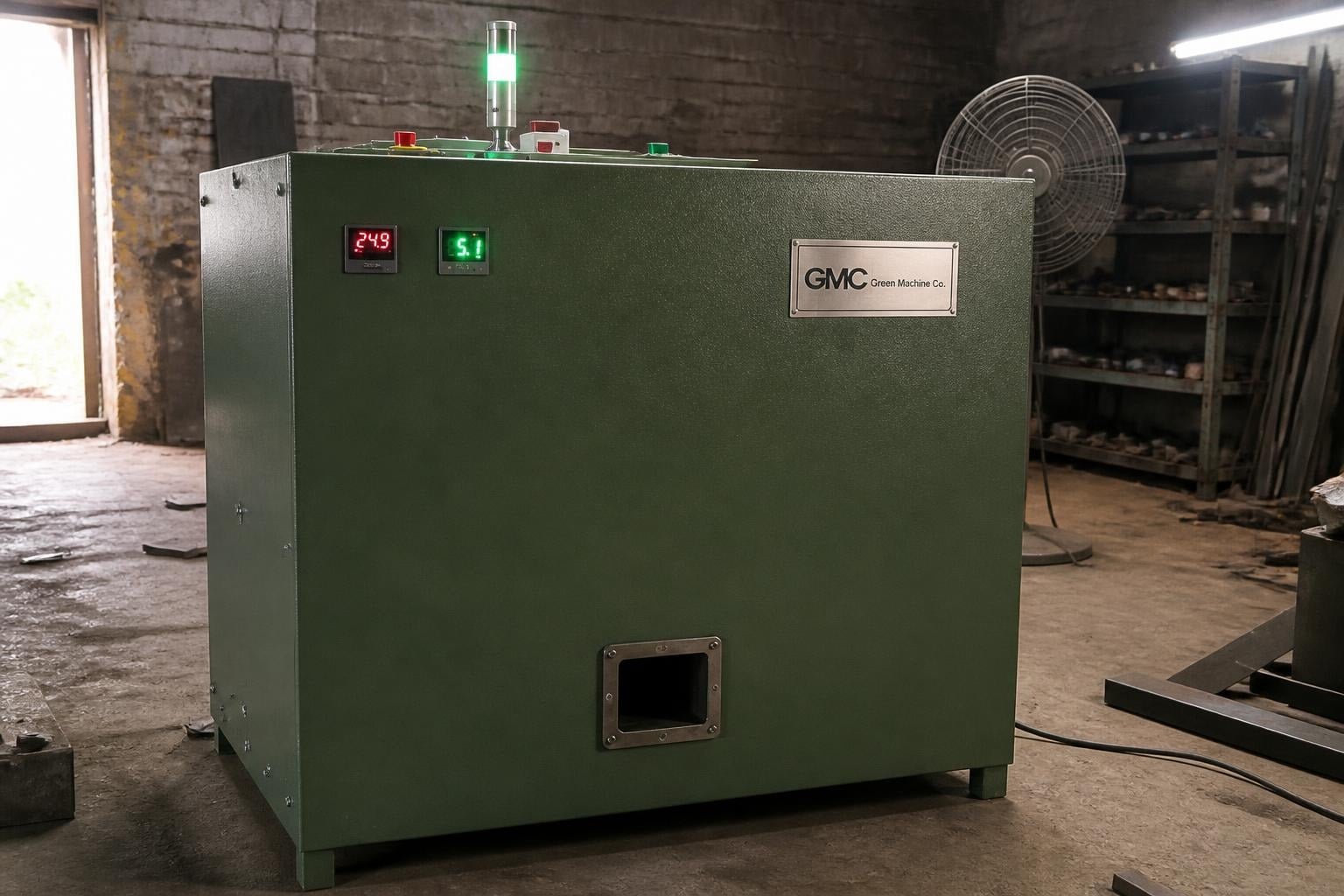
A composting machine is a ten-year relationship. The supplier matters more than the specification sheet, because the specification is fixed on the day you sign and the relationship is what you live with afterwards.
- 1See a machine running. Not a factory tour. An operating installation, at least three years old, at a site comparable to yours. Ask the people who run it what breaks.
- 2Find out who does the engineering. A great deal of this market resells machines designed by someone else. When a gearbox fails in year four, you need the people who chose the drive, not the people who printed the badge.
- 3Check service reach. How far away is the nearest engineer, and what response time will they commit to in writing?
- 4Check spares. Are the consumables and wear parts standard items you can buy anywhere, or proprietary parts from a single source?
- 5Ask for documentation. General arrangement drawing, electrical schematic, O&M manual, spare parts list. A supplier who cannot produce these does not have them.
- 6Read the warranty exclusions. Not what it covers. What it excludes, and what voids it.
Seven Mistakes That Cost Real Money
Each of these is worked through in detail in 7 mistakes buyers make.
- 01Buying before fixing segregation. The machine cannot separate plastic from potato peel, and it will not learn.
- 02Sizing on the average day. Banquets, festivals and full occupancy are precisely when the machine has to work.
- 03Comparing prices instead of specifications. Two machines both labelled 100 kg are frequently not the same machine.
- 04Not establishing output maturity. Finished material and material needing three weeks of curing require completely different space, labour and planning.
- 05Forgetting the operator. Someone has to load, discharge and clean it every day. Name that person before the machine arrives, not after.
- 06Treating exhaust and drainage as afterthoughts. These generate the complaints that get machines switched off and left switched off.
- 07Choosing on price alone. The cheapest machine tends to arrive with the shortest life, the scarcest spares and the most distant service engineer, and you meet all three in the same week.
Frequently Asked Questions
How long does an organic waste converter take?
Designs vary widely. Some run a 24-hour cycle and discharge immature material that then needs two to three weeks of curing. Others are designed to complete the process in-machine. Ask for the cycle time and the maturity evidence together, because either number on its own tells you very little.
Does the output need curing?
In many machines, yes. Ask any supplier for laboratory test results rather than a claim, and read the C:N ratio against the FCO benchmark for the use you have in mind.
TGMC’s composters complete their machine cycle in 4 to 6 hours. Supported by independent testing at a NABL-accredited laboratory.
Does an organic waste converter smell?
A machine that is correctly sized, correctly loaded and correctly ventilated should not. Odour complaints almost always trace back to overloading, poor segregation, insufficient aeration, or an exhaust routed past somebody’s window. They are rarely a problem with the technology.
How much space is needed?
Footprint, plus working clearance around it, plus covered space for handling the output. Confirm the access route as well, including doorway and lift dimensions, not only the final position.
What can’t go into the machine?
Plastics, metal, glass, cutlery, packaging, large bones, and in most designs large quantities of liquid. Some designs also restrict citrus and coconut shell unless a shredder section is fitted.
Can the compost be used on any crop?
Not without care. Compost produced from mixed food waste can carry E. coli, which is normal for the feedstock and manageable, but it means the output should not be applied to crops that are eaten raw without further composting or curing. Ask your supplier for the microbiological section of their test report, not just the nutrient analysis. Any supplier who has never been asked this before is telling you something.
Do I legally need one?
Bulk waste generators carry an obligation under the Solid Waste Management Rules 2016 to process biodegradable waste on the premises as far as possible. Whether it applies to you depends on your generation volume, your state, and how actively your municipal body enforces it.
Know your daily wet-waste figure? We will check it against a machine size.
A TGMC engineer walks your site, measures the access route and the power supply, and puts the kg-per-day basis in writing before any quotation is issued.
Or call +91 90737 96770 · info@tgmc.co.in
Where to Go Next
If you have your seven-day weight figure and want it checked against a machine size, our composter machine range is organised by kg per day. Sites with high-moisture waste should also look at dewatering, which reduces volume before composting. Smaller kitchens and homes are usually better served by the Wastemaster. And if you want to understand what happens if you do nothing, we have written about where food waste ends up in landfill.
Written and technically reviewed by Devanshu Daga, Founder, The Green Machine Co., Kolkata (ISB PGP; Six Sigma Black Belt). Last updated 19 October 2026.